Snowbird Season Survival Guide
You can feel it before you see it. The grocery store is suddenly out of prune juice. There’s a Buick doing 23 in a 45 on the road you’ve driven for fifteen years, piloted by someone wearing a sun visor the size of a satellite dish. Your dentist’s parking lot has a Michigan plate in it. Yes, friends, the snowbirds are back, and like the swallows returning to Capistrano, they arrive on schedule, in flocks, and with a complete disregard for the local traffic patterns.
Let’s be clear: we love our seasonal neighbors. They keep our restaurants open, they tip well, and they are the only people in Florida who think 68 degrees is “gorgeous.” But every November, the population of our roads roughly doubles overnight, and half of those drivers haven’t seen this intersection since April. They don’t know the left-turn lane got moved. They don’t know the Publix closed and reopened across the street. They are navigating by memory and vibes, and the vibes are from 2019.
So this is your friendly, slightly cranky, legally informed reminder that the next five months are going to require a little more patience, a little more space, and a lot more attention. Consider it a survival guide. Consider it a public service. Consider it a gentle nudge from a law firm that would, frankly, prefer you didn’t need us this winter.
Rule One: Leave Early. Rule Two: Leave Earlier Than That.
That 12-minute drive to work? It’s 25 now. The quick run to the bank? Budget 40 minutes and bring a snack. Snowbird season is not the time to shave your departure to the last possible second, because somewhere between you and your destination is a sedan from Ontario trying to merge onto the highway at the speed of a riding mower.
Here’s the thing about running late: it turns perfectly reasonable people into tailgaters, lane-weavers, and yellow-light gamblers. And rear-end collisions, the single most common crash we see in this office, almost always come down to two things: following too closely and not paying attention. When the car ahead of you is driven by someone who may brake suddenly for a pelican, a turn they almost missed, or no discernible reason at all, that three-second following distance is not a suggestion. It’s the difference between a mild annoyance and a neck injury that follows you around for two years.
So give extra distance. Then give a little more. If someone cuts in front of you to fill the gap, congratulations, you’ve made a new friend. Back off again. The goal is to get there, not to win.
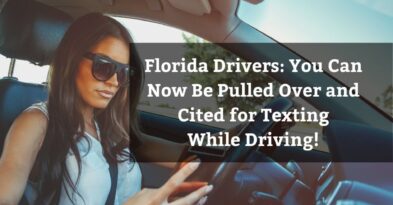
And awareness. We cannot say this enough. Snowbirds make unexpected moves: sudden stops to read street signs, right turns from the left lane, U-turns in places where U-turns were never meant to happen, and the classic “stopped dead in the middle of a roundabout because I genuinely don’t know what this is.” None of that is going to hurt you if you’re watching the road. All of it will hurt you if you’re watching your phone. Put it down. Your group chat about the cousin’s wedding can wait until you’re parked.
One more thing while we’re here: this is also when the sun sets at 5:30 and you’re driving home into a glare that could blind a welder. Keep sunglasses in the car. Clean your windshield. Turn your headlights on before you think you need to. Visibility problems plus unfamiliar drivers plus rush hour is a recipe we’d rather you didn’t taste.
Snowbird Season Is Also Holiday Season, Which Means the Parking Lot Is Now a Thunderdome
As if doubling the number of drivers weren’t enough, the universe scheduled snowbird season to land squarely on top of the holidays. So now you’ve got twice the cars, and every single one of them is trying to get into the same Target parking lot on a Saturday, driven by someone who is stressed, hungry, running late, and mentally composing a text about who’s bringing the sweet potatoes.
Parking lots are, statistically, one of the most dangerous places you’ll be all season, and not because of speed. It’s because nobody is looking. The driver backing out of a space is looking at the backup camera, which doesn’t show the shopping cart rolling in from the left or the kid who just broke free from his mother’s hand. The driver cruising the row for a spot is looking at a space, not at the pedestrian stepping off the curb. And the pedestrian stepping off the curb is looking at her phone, because her sister just texted that the store is out of the thing she drove here for.
The result is a daily parade of fender benders, backing collisions, and pedestrians clipped at 5 miles an hour. Five miles an hour sounds like nothing. Five miles an hour against a 70-year-old hip is a surgery, a rehab stay, and a very long winter.
So in the lot: drive like everyone is invisible and the pavement is covered in toddlers. Back in if you can, so you pull out forward with a full view. Don’t cut across the empty rows diagonally, because the person who does that is the person who gets T-boned. And if someone takes the spot you were clearly waiting for, let it go. There is no parking space worth a trip to the ER or a trip to see us.
Inside the Store: Slips, Trips, and the Shopping Cart Tango
You made it through the parking lot alive. Don’t relax yet. The inside of a crowded store during the holidays is its own little obstacle course, and we see the results every January.
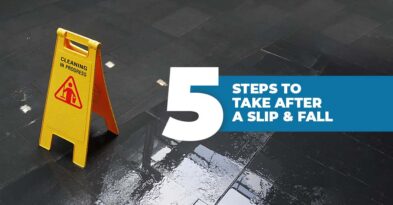
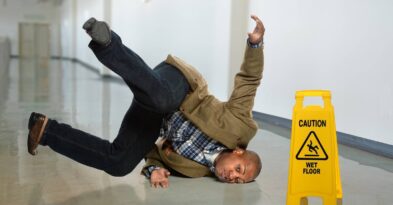
Start with the floor. Rain gets tracked in by a thousand pairs of shoes, the produce mister keeps the tile by the lettuce permanently slick, and somebody’s grandchild just dropped a full cup of lemonade by the registers. Stores are supposed to inspect, clean up, and put out those yellow cones in a reasonable amount of time, and when they don’t, that’s a premises liability case. If you go down, don’t be embarrassed and don’t wave it off. Report it to a manager before you leave, take a photo of whatever you slipped on, get the names of anyone who saw it, and get checked out even if you “feel fine.” Adrenaline is a liar. The back that feels fine in aisle seven feels very different at 3 a.m.
Then there’s the merchandise. Holiday displays get stacked high and fast by seasonal staff, and “falling merchandise” is a real category of injury, not a cartoon gag. If a store builds a pyramid of 12-packs or a tower of air fryers, it’s responsible for building it so it doesn’t come down on your head.
And then, of course, the carts. A loaded shopping cart weighs more than you think and steers worse than you’d hope, especially when it’s being pushed by someone looking sideways at the gift wrap. Ankles get rolled over. Shins get clipped. Toes get crushed. It’s funny right up until it’s your foot.
Outside, the sidewalks and crosswalks deserve the same caution. Pedestrian accidents spike this time of year, partly because of the crowds and partly because of the drivers we already discussed. Cross at the crosswalk, make eye contact with the driver before you step off the curb, and assume the turning car does not see you, because it probably doesn’t. Dusk is the worst. Wear something that isn’t black if you’re walking after five.
While You're at It: The Boring Insurance Paragraphs That Could Save You a Fortune
We’d be bad lawyers if we got you this far and didn’t bring up coverage. Stay with us. This is the part people skip, and it’s the part that decides whether a bad winter is survivable or catastrophic.
First, Uninsured/Underinsured Motorist coverage, or UM. Florida only requires drivers to carry $10,000 in personal injury protection and $10,000 in property damage liability. Bodily injury liability, the coverage that pays for the people you hurt, is not required at all for most drivers. Think about that. A huge share of the cars around you this season are carrying zero dollars to cover your medical bills if they hit you. Add in the out-of-state visitors with minimum policies from home, the rental cars, and the rideshare drivers in the gap between trips, and you start to understand why UM matters. UM coverage is on your own policy. It steps in when the person who hit you has nothing, or not enough. It’s usually cheap, your insurer will try to talk you out of it or make you sign a waiver, and it is the single most important line on your auto policy. Call your agent this week and ask how much you have. If the answer is “none” or “I’m not sure,” fix that.
Second, your homeowners policy. Snowbird season means more guests, more parties, and more people on your property, which means more opportunity for someone to trip on your step, slip by your pool, or get a little too friendly with your dog. Make sure your liability limits are real numbers and not whatever the policy came with in 2011. Check that your dwelling coverage reflects what it would actually cost to rebuild today. And if you’re a snowbird yourself, check whether your policy has a vacancy clause that quietly cancels coverage after the house sits empty for 30 or 60 days.
Third, flood. Your homeowners policy does not cover flood. Read that again. It doesn’t matter how good your policy is, how far you are from the coast, or whether the house has ever flooded before. A storm doesn’t check your flood zone before it parks over your neighborhood for three days. Flood policies typically have a 30-day waiting period, so the time to buy one is not when the Weather Channel starts naming things. It’s now, while it’s boring.
Injured This Snowbird Season? We’re Here to Help.
If you’ve been hurt in a car accident, pedestrian accident, or slip and fall, Fischetti Law Group can help you understand your options.
Contact Fischetti Law GroupThis article is provided for general informational purposes only and does not constitute legal advice. Reading this article does not create an attorney-client relationship. Insurance coverage and legal rights depend on the specific circumstances and policy terms.